
"I don't believe Saltspring Soapworks would have worked anywhere else."
— Linda Quiring
People often ask how Saltspring Soapworks began.
The answer starts long before the first bar of soap.
It begins with an island.
When we sat down with retired founder Linda Quiring to talk about the early days in the 70's, one thing became immediately clear: she never set out to build a business. She and her husband Bill were simply searching for a different way of living.
The company that would eventually become Saltspring Soapworks grew naturally from the place they chose to call home.
"Let's move to Salt Spring Island."
When Bill and I first met in Vancouver, both of us were beginning to reject the big city lifestyle.
All of us had long hair! We were among the first "hippies" who were just beginning to appear. The West Coast had attracted many draft dodgers, and I believe they changed our culture forever.
Like them, we were drawn to communal living, growing our own food, and abandoning the desire for new cars and fancy clothes. But it costs a lot of money to live in a big city, and you have to commit to a certain lifestyle to earn that money. Philosophically, that just wasn't who we were anymore.
So one day, completely out of the blue, Bill said,
"Let's move to Salt Spring Island!"
Bill had never actually been there.
As a small boy, his mother had once told him, "They grow nuts there!" Later, while commuting each day to a toxic plastics plant, he remembers driving through the smog with four other men who spent every morning talking about hockey.
One day, the sun broke through toward the ocean.
Someone pointed to a cluster of islands glowing in the distance and said,
"Look. There's Salt Spring Island."
That was enough.
"Okay," I said. "Let's move there."

Finding Rainbow Road
We found a realtor somewhere who lived on one of the Gulf Islands—not even Salt Spring—and arranged to meet him on the ferry. He told us he'd be wearing a red tie.
We had coffee, explained that we wanted to sell my little house in Vancouver and "go back to the land."
I was a prairie girl from an Eastern European family that had farmed wheat for generations. This was my very first time ever setting foot on an island.
The realtor drove us into Ganges.
This was a town?
Just a handful of buildings around a beautiful harbour full of sailboats.
We looked at a few houses.
Then the local realtor took one look at us—long hair, handmade clothes, lots of beads, Bill's beard, probably a gentle whiff of patchouli—and smiled.
"I have just the place," he said.
"It's on Rainbow Road."
Rainbow Road.
How romantic.
We drove down a tree-lined road, turned into the forest, and there it was.
A small A-frame tucked beside a rushing creek.
A waterfall.
A huge deck overlooking the trees.
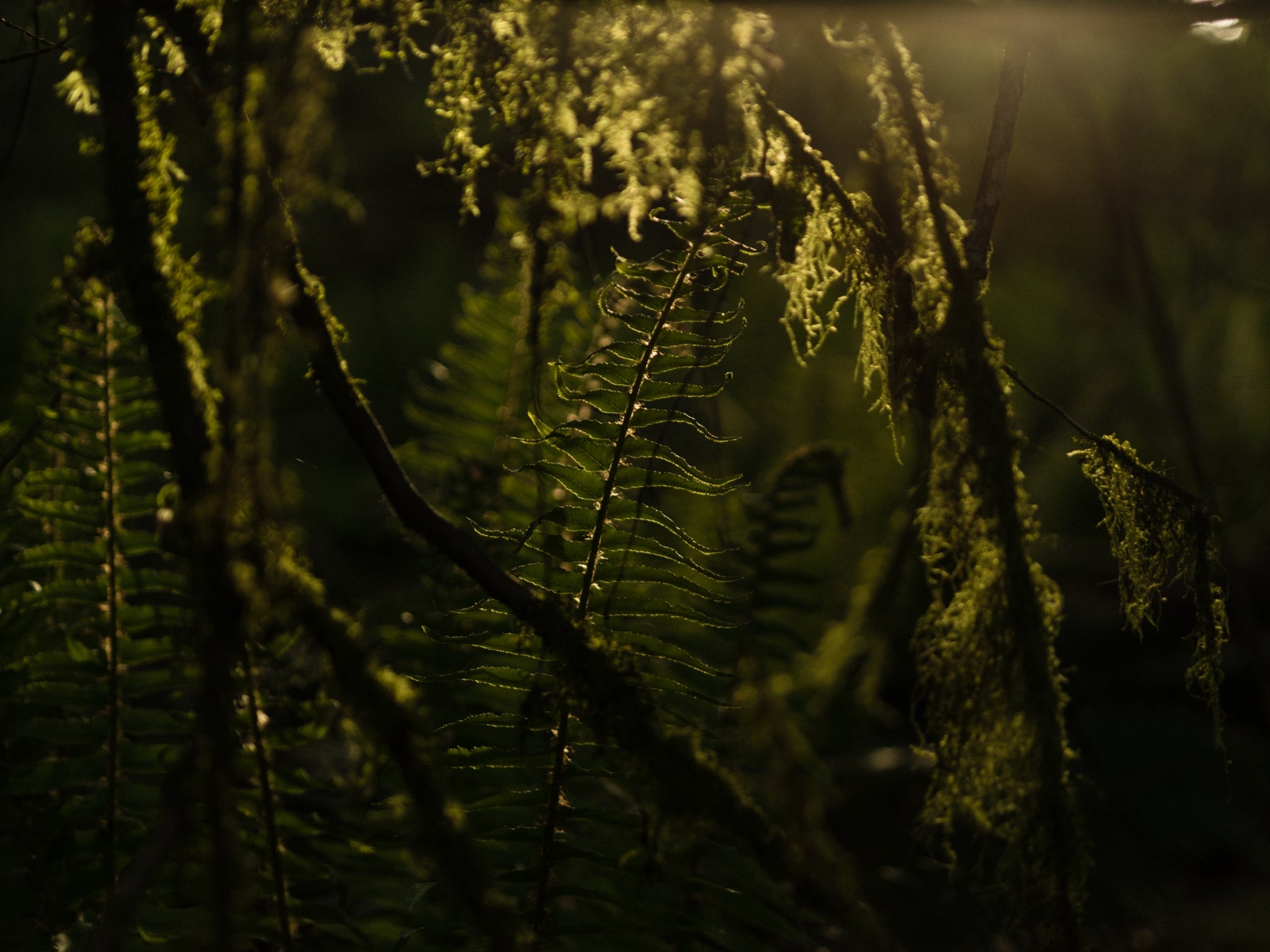
The wind moving through the forest.
Rain tapping on the windows.
Complete silence.
No neighbours in sight.
"We'll take it," we said.
It was exactly what we had been looking for.
It was December.
Nobody mentioned that the creek dried up every summer, and it was dark all year.
We were in shock
We signed the papers and caught the ferry back to Vancouver.
The whole trip home we looked at each other in disbelief.
"Bill," I asked, "did it have a laundry room?"
"I think it did."
Neither of us was completely sure.
"Do you remember how to get there?"
No.
But we had the address.
I went home, listed my house, quickly sold it, and quit my job as executive assistant to the CEO of one of Western Canada's largest transportation companies.
The little country cottage cost about half what my Vancouver house sold for.
For the first time in our lives, we had enough money that we didn't need jobs.
We had escaped the system.
An island unlike anywhere else
Soon we discovered Salt Spring was full of people who thought the way we did.
It was an extraordinary time.
The Vietnam War had changed everything.
The music changed.
The culture changed.
People were questioning what mattered.
Salt Spring had become home to artists, craftspeople, free thinkers, farmers and people looking for a different way of life.
It had attracted a different kind of consciousness.
That was what made the island so unique.
I don't believe Saltspring Soapworks would have worked anywhere else.
I didn't really start a business.
It just kind of evolved.
The way it began simply couldn't have happened in another atmosphere.
I can still remember one of the first little craft fairs at our community hall.
It was tiny.
Simple.
But there were so many people making beautiful things by hand.
That was Salt Spring.
More than a place
Of course, not everyone welcomed the changes.
Salt Spring had long been home to loggers, sheep farmers and fishermen.
Then developers began buying large pieces of land, planning subdivisions that would have transformed the island into another suburb.
Many people fought to protect what made the island different.
Laws were eventually passed that helped preserve the character of the community.
Looking back, it's hard to separate the story of Saltspring Soapworks from the story of Salt Spring Island itself.
The quiet.
The creativity.
The independence.
The belief that making something by hand still mattered.
Those weren't just the beginnings of a company.
They were the beginnings of a way of life that continues to shape Saltspring Soapworks today.